
Arrivederci: Gone Fishing, An Early History of Italian-Americans in Sea Isle City
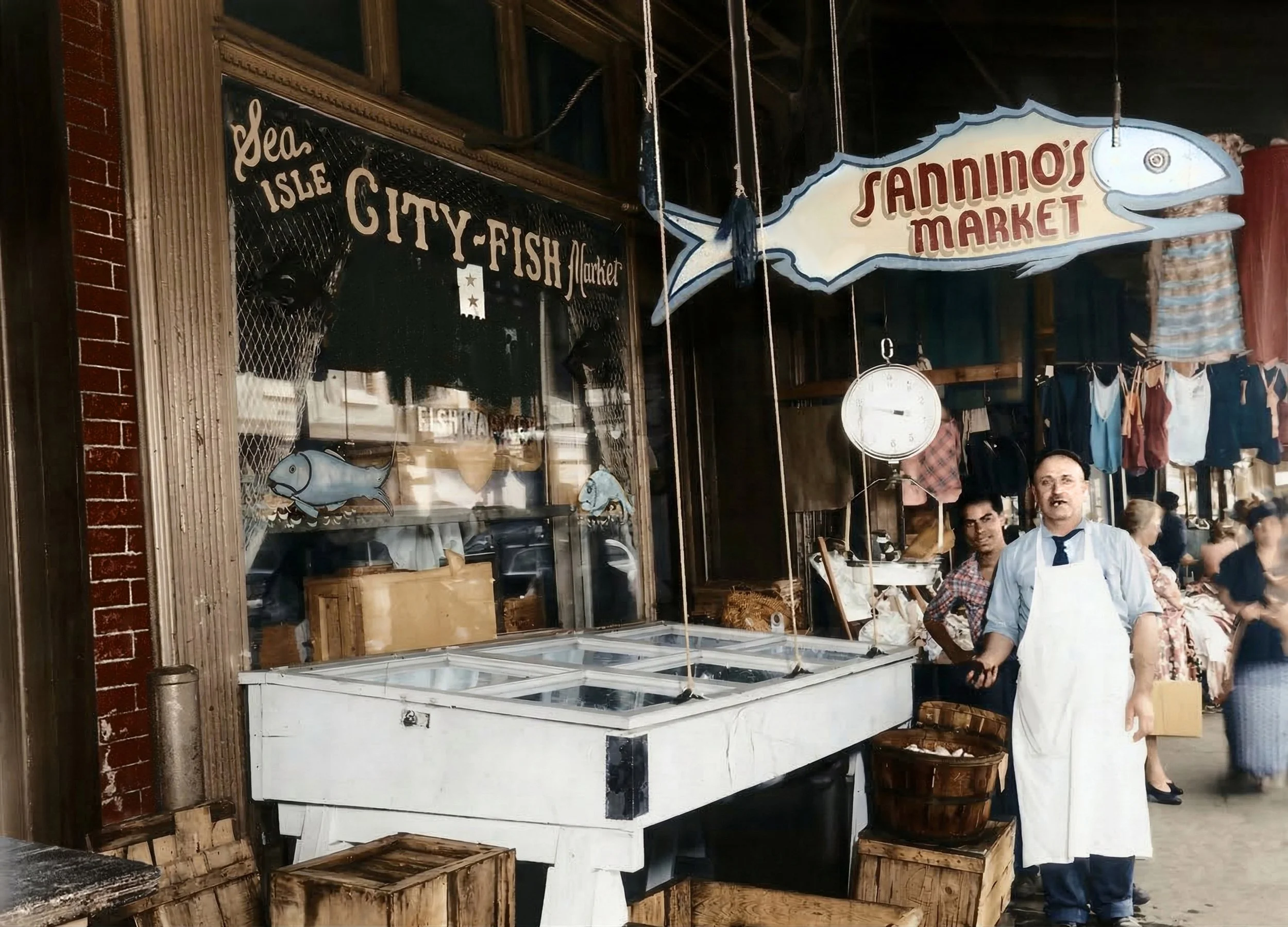
The old Sannino’s Market was a local seafood place, located in the Italian market in South Philadelphia. During the winter months, it supplied Philadelphians with fresh seafood and other necessities. Take note of the Sea Isle shoutout on the store window. When summer rolled around, the Sanninos headed to the Shore and sold their fresh fish at their Market on 43rd Street. Pictured here is Mike Monichetti’s grandfather, Captain Joe Sannino and his son, Jim Sannino.
To many people, the thought of Sea Isle City conjures up visions of warm summer days frolicking in the surf, and evenings of leisure enjoying balmy weather at the shore. At the turn of the 20th century, it meant something totally different to scores of newly arrived Italian-Americans. It meant an opportunity to escape the poverty of what is now Southern Italy, and start a new life in a new country where the “streets were paved with gold.”
The migration out of Southern Italy in the late 19th and early 20th centuries created a large diaspora, centered mostly in the large cities along the eastern seaboard. Many of these newly arrived immigrants took menial jobs to support themselves and their families.
Sea Isle City was founded in the 1880s and immediately prospered due to its direct connection to the railroad. This transportation lifeline was very important in the time before automobiles, as it provided inexpensive, quick transportation. Due to direct rail connections, the seaside resorts of Atlantic City, Sea Isle City, and Cape May thrived, seeing thousands of visitors during the summer months. In order to protect his investment, Charles K. Landis, founder of Sea Isle City, imported newly arrived Italian-American laborers to keep and maintain the railroad.
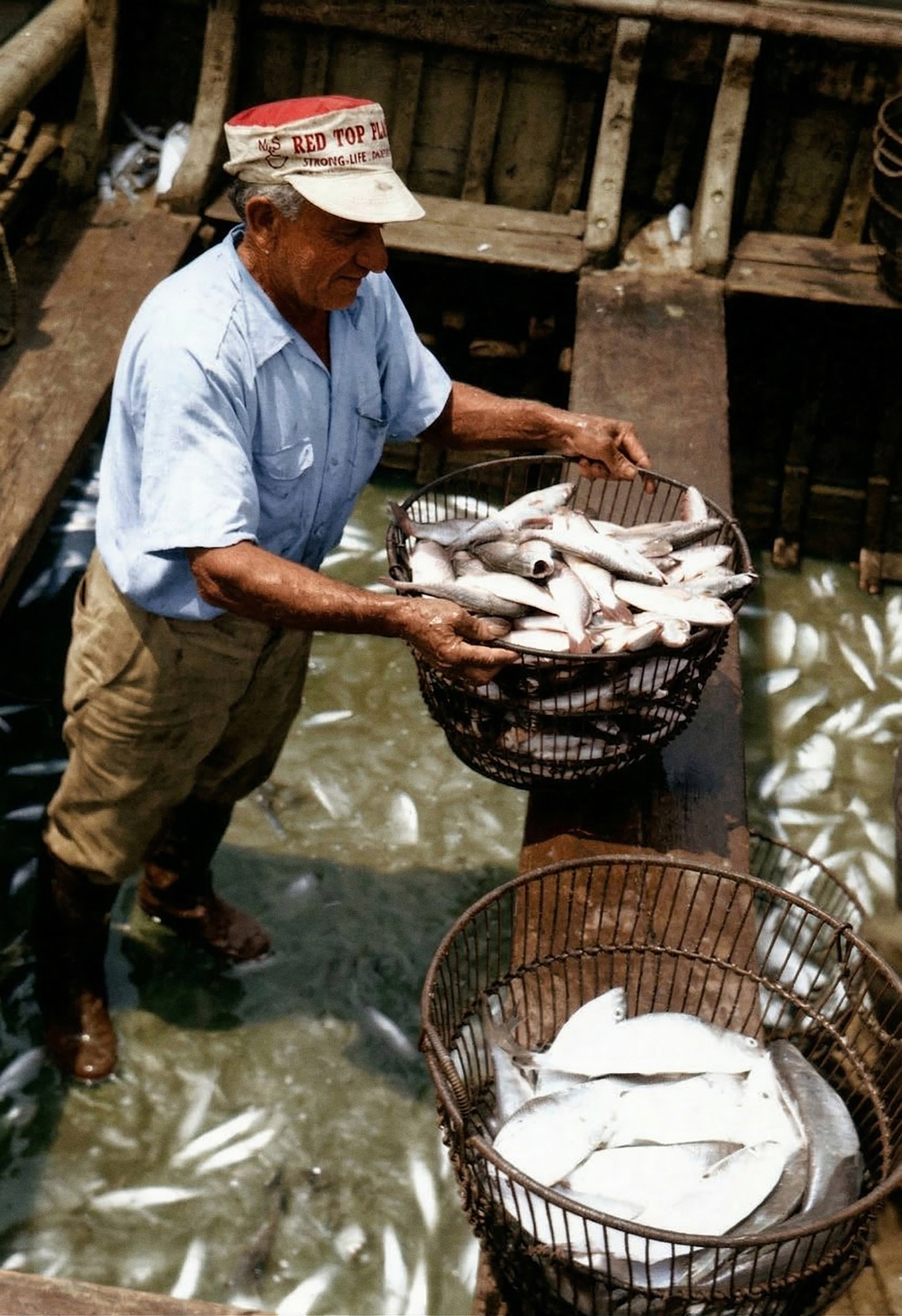
Pasquale La Rosa, owner of the Pound Nets Fishing Company, cleaning his boat in the early afternoon.
News of the small seaside community of Sea Isle City that welcomed Italian immigrants soon spread. In 1895, the first Cape May County barrier island census listed 13 Italian-Americans calling Sea Isle City home. Many more soon came flocking to the resort, searching for their fresh start in America.
This was true for a group of immigrants working at the Stetson Hat factory in Philadelphia who were unhappy in their current positions. Some decided to try their luck in commercial fishing. There had been commercial fisheries in Sea Isle City almost from its very beginning, and a few of the immigrants had been fishermen in their native country.
After leaving the hat factory, Pasqaule La Rosa took a position working in a brickyard in Hammonton, another New Jersey community founded by Landis that was also very welcoming to newly arrived Italian-Americans. The work at the brickyard offered no future, so he decided to move to Sea Isle City and start a fishing business along with a few acquaintances from the hat factory. In his youth he had worked on fishing boats in the Straits of Messina, near his home in Sicily.
As new modern engines were developed, commercial fishermen no longer needed to row out through the surf to access the fish. Rather, they could dock their boats on the bay side of the island and motor out to the ocean through the nearby inlet. Early fishermen employed what are called “pound net” fisheries. An easy way to explain a pound fishery was that it is a maze of nets that trap the fish in a central pocket of netting. The pocket is then manually lifted into an open boat and dumped. The fish are loaded into the bottom of the open boat and brought to port. Once in port they are sorted, boxed in ice, and prepared for markets.
In addition to pound fishing, powerful engines gave rise to three other forms of commercial fishing in Sea Isle City: long-lining, dragging, and pot fishing. Long-lining entails baiting long lines of rope, with hooks placed at specific intervals, and seeing what bites. Dragging is self-explanatory: It is merely dragging a very large net behind your boat and seeing what you catch. Pot fishing is using wooden traps to capture fish. As time moved on, most of the fishermen used the dragging method in Sea Isle City.
Pasquale La Rosa ran the last of the fish pounds. His fish house was located on 42nd Place and the bay, at the site of what now is the Oar House Pub. Many Italian-Americans were drawn to the fishing industry here. In alphabetical order, their family names were Annunucato, Barbagello, Braca, Bufalo, Cannavo, Castaldi, Constantino, Conti, Coppa, D’Intino, Izzi, Lamanna, La Rosa, Lepore, Libro, Marini, Mazzoni, Monichetti, Montagna, Ordile, Pessalino, Pittaluga, Pratico, Primavera, Raffa, Romano, Rosetti, Sanfosso, Sannino, Sivi, Terusso, and Vitiello. They either owned or worked in fisheries, or had family members who worked any of the many boats that called Sea Isle City home.
The fishing industry was centered on the bay area in the middle of town. Landis, Sea Isle City’s founder, had named these waterways in Italian: the Rio Del Affare, or River of Business, between 42nd and 43rd Place; and the Rio del Barche, or the River of Boats, between 43rd and 44th Place. The Italian-American-led fishing industry was vibrant from the 1920s until the 1960s, when the area became depleted.
As fishing prospered through the 1920s to the 1950s, many of these Italian-Americans achieved their American Dream of homeownership, financial security, and personal freedom. These Italian-Americans endured brutal hours and backbreaking labor to provide their dream to their families. The immigrants were correct; streets of America were paved with gold. The gold was the endless opportunities that were offered to them.
Traditionally, all male family members worked on the boats. These first-generation Americans spoke Italian or Sicilian at home, and learned English at school. However, the American Dream also included responsibility, as all available male family members went on to serve their country during both world wars and the Korea War. Unfortunately, one of Sea Isle City’s Italian-American native sons, U.S. Army Capt. Celestine “Chel” Lamanna, did not return home from World War II, losing his life in France. In late January 1942, three fishermen – Dewey Monichetti, John Monichetti, and Dominic Constantino – rescued the crew of the Norwegian tanker Varanger, after it was torpedoed by a U-boat off of Sea Isle City.
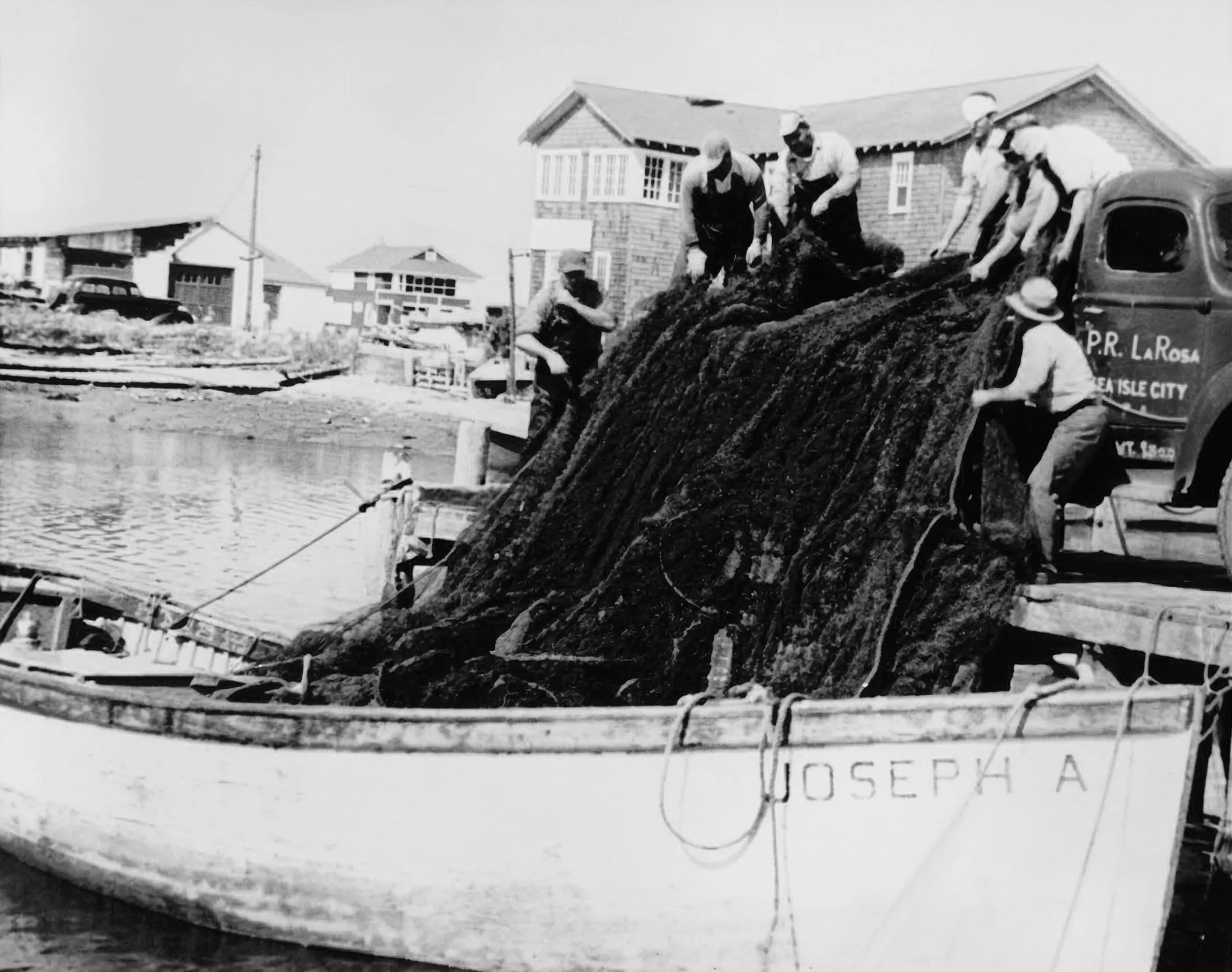
The crew of the Pound Nets Fishing Company tending the nets after a long day on the ocean. The cotton nets needed to be dried daily, and periodically tarred to prevent rotting. Nets were dried at the site of what is now the Islander Plaza. The fish house and dock were located at what is now the site of the Oar House Pub.

Lou Bufalo Sr. and Jr., with their crew sorting the day’s catch and preparing if for market.
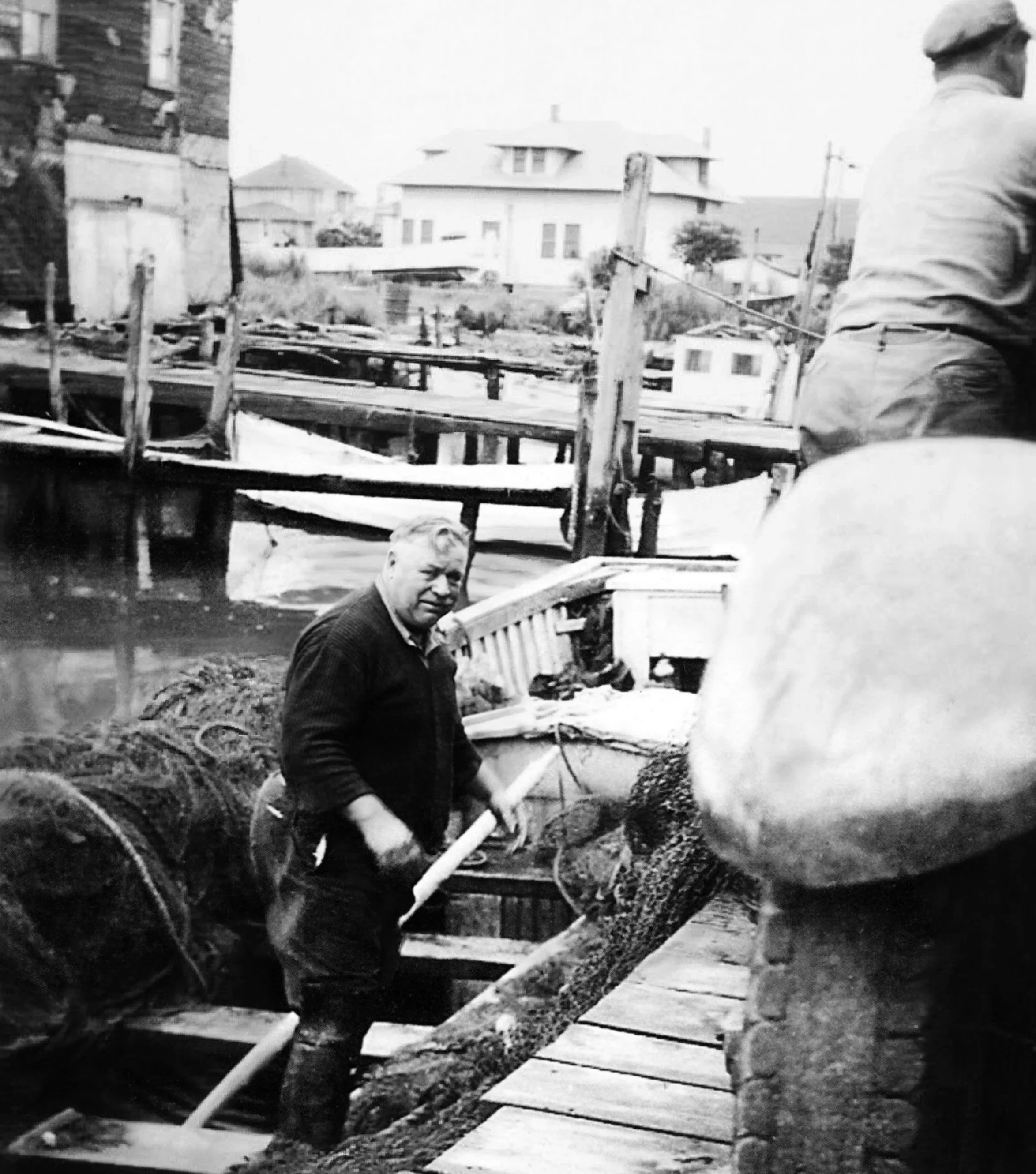
Pasquale La Rosa, owner of the Pound Nets Fishing Company, cleaning his boat in the early afternoon.
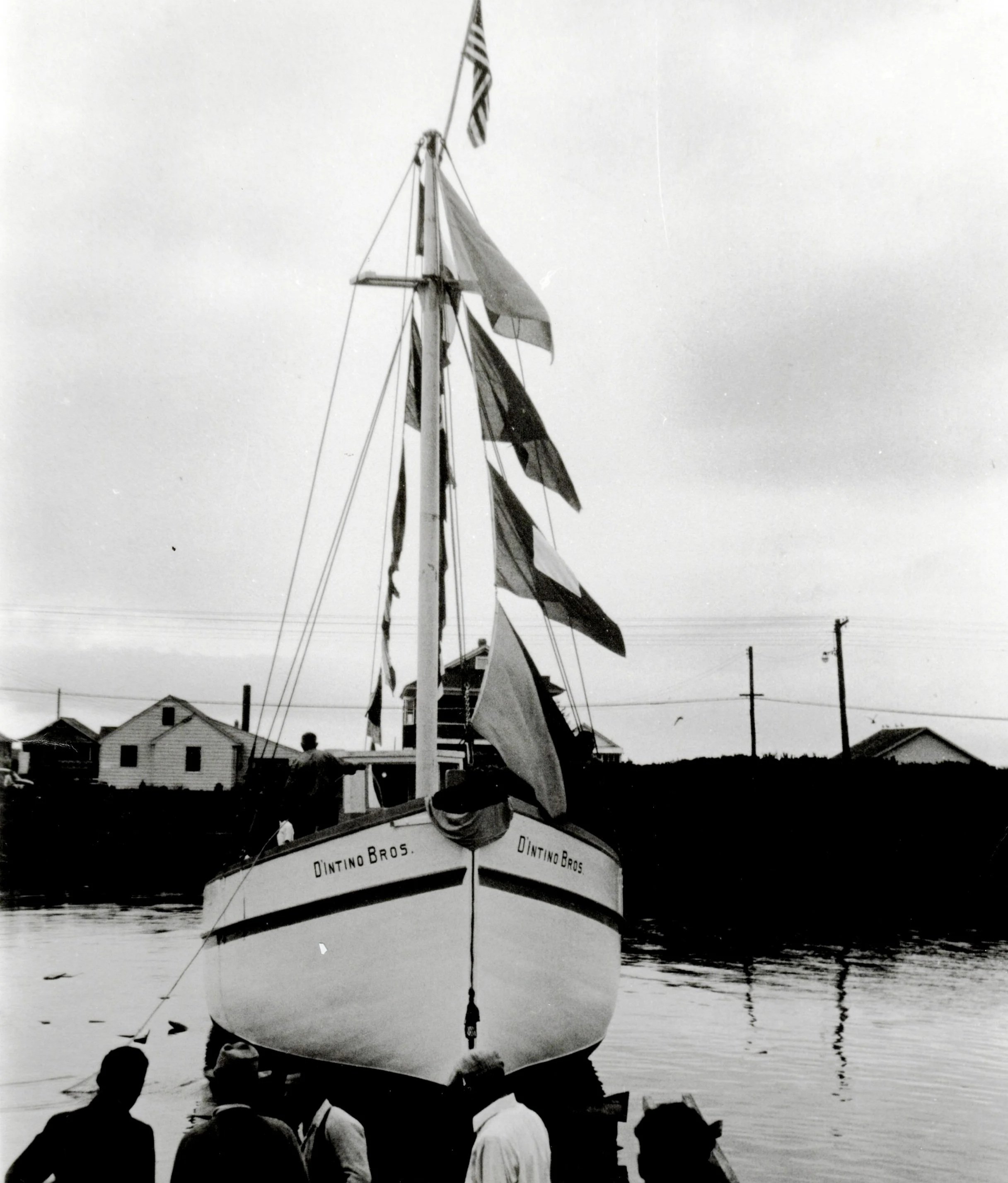
D’Intino Brothers’ fishing vessel being launched after its christening. The boat was built by Stefanu Libro, and his son, G.B. “Dan” Libro at what is now the site of CP Rankin Roofing on 42nd Place. Please notice the American flag flying proudly at the top of the Main Mast.
As the Italian-Americans were establishing a community in Sea Isle City, the older ruling class of the city was welcoming, but also wary of the changes that these new people brought with them. For their part, the Italian-Americans did their very best to assimilate into society. In many houses, Italian was not allowed to be spoken. “You are in America, you speak English,” was the mantra of many of the immigrants, as they attempted to ensure that their children would be “100% American.” But also to the ruling class, the very large Italian-American population of the town represented a potential windfall of votes, waiting to be cast.
In response to this, and along with other social and economic factors, the Committee of Eight was organized in Sea Isle City by some of the more active immigrants. The committee consisted of John Braca, Louis Braca Sr., Antonio Curatolo, Paolini Falconi, Peter Lamanna, Pasquale La Rosa, Gaetano Libro, and Filippo Pratico. The result of this community action was the founding of the Italian-American Club of Sea Isle City. Still active in the community, the idea behind the club was for the Italian-American citizens to work as a unit to the mutual benefit of all. After getting organized and gaining membership, a “Mass Meeting” was held in the resort in March 1937. The direct result of the rally was that the club would run a candidate for the City Commission in the upcoming nonpartisan municipal election. Lamanna, a son of the city’s letter carrier, was selected to run.
The first Italian-American to be placed in any position of authority in Sea Isle City was Antonio Cannavo. He was a community leader, and was appointed as captain of the beach patrol in 1924. He was the town’s first citizen to enlist in the service during World War I. After seeing combat, he returned to become a member of the volunteer fire company while also becoming a charter member of the town’s American Legion post as well as a charter member of the Italian-American Club.
Political change came slowly to Sea Isle City, but in May of 1960, two first-generation Italian-Americans, Vincent L. Lamanna and Dominic C. Raffa, were elected to the three-person City Commission. Lamanna was chosen as mayor from among the commissioners. He was the brother of Peter Lamanna, who had run unsuccessfully for the City Commission 23 years earlier, and “Chel” Lamanna, who was a World War II casualty. Raffa was the son of an immigrant who lost his life at sea while working on one of the commercial fishing boats. Mayor Lamanna was the guiding hand behind the community’s rebuilding after it was destroyed by a terrible storm in March 1962.
The oldest continually run business in Sea Isle City is Braca Café, now run by a fourth-generation member of the extended Braca family. Other second-, third- and fourth-generation members from the original families are still very much part of the community. Pittaluga Electric has been in operation for many years, as well as Pittaluga Masonry. Joseph A. LaRosa III, a third-generation Italian-American is currently a captain with the Sea Isle City Fire Department. Tom D’Intino, a second-generation member of an immigrant family, recently retired as the community’s police chief.
Mike Monichetti, a second-generation member of both the Monichetti and Sannino families, operates Mike’s Seafood, which can trace its roots back to Mike’s grandfather’s original fishing business. Another seafood restaurant is Carmen’s Seafood on 43rd Place. Recently deceased, Carmen was still active at 96 years old. He was a first-generation Italian-American, and continued the fishing business where his father worked. It is still run by his wife of 60 years, Ruthy. The Romano family still operates Marie’s Seafood, also a direct descendent of a family fishing business. The three seafood restaurants are located on what is now called “Historic Fish Alley.”
Fish Alley was originally a detrimental term used to describe the location where most Italian-Americans had settled, as well as a deprecating description of the people themselves. Happily, that is now in the distant past as the term now confers pride to the residents who called it home.
As the 1970s arrived, Dominic C. Raffa was elected mayor. And in 1993, Leonard Desiderio assumed the position of mayor that he still holds.
The older Italian-American families in the community remain very proud of their heritage and their deep roots in Sea Isle City. However, what makes many of them proudest, is that they became what was desired and dreamt by their older family members: “100% American.”